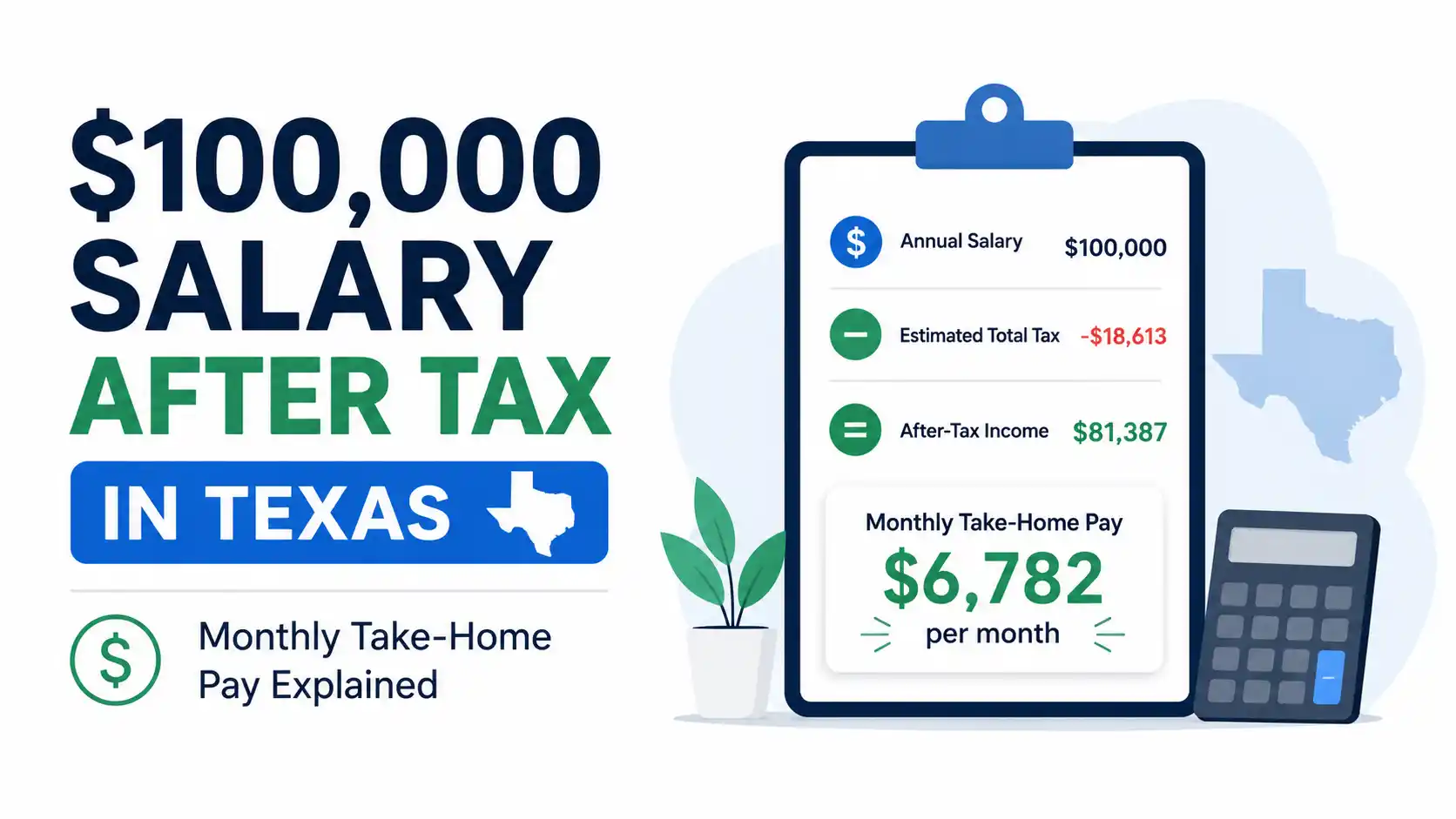
A few years ago, one of my friends got a job offer in Texas with a salary package of $100,000 per year. His first reaction was exactly what most people think:
“Wow, I’m going to be rich.”
A week later, he called me after seeing his estimated paycheck deductions and asked a much more realistic question:
“How much money will actually hit my bank account every month?”
That question matters far more than the headline salary.
Whether you’re moving to Texas for work, comparing job offers, planning a relocation, or simply curious about how far a six-figure salary goes, understanding your actual take-home pay is essential.
The good news is that Texas is one of the most tax-friendly states in the United States because it does not charge state income tax. That alone can make a significant difference compared to states like California or New York.
Let’s break down exactly what a $100,000 salary after tax in Texas looks like and how much you can realistically expect to keep each month.
Why a $100,000 Salary Doesn’t Mean $100,000 in Your Pocket
One of the biggest mistakes people make when evaluating a job offer is focusing only on the gross salary.
Your employer may pay you $100,000 annually, but several deductions happen before the money reaches your bank account.
These typically include:
- Federal income tax
- Social Security tax
- Medicare tax
- Retirement contributions
- Health insurance premiums
- Other optional benefits
The result is that your actual spending money is lower than the advertised salary.
I learned this lesson when helping a relative compare offers from different states. A lower salary in Texas sometimes produced a higher take-home paycheck than a larger salary elsewhere because there was no state income tax.
Texas Has No State Income Tax
This is one of the biggest financial advantages of living in Texas.
Unlike many states, Texas does not take a percentage of your income through state income tax.
That means your paycheck only needs to account for:
- Federal taxes
- Social Security
- Medicare
- Any voluntary deductions
For high earners, this can save thousands of dollars every year.
Many professionals moving from California, New York, Illinois, or New Jersey are surprised by how much more of their paycheck they keep after relocating to Texas.
Estimated Take-Home Pay on a $100,000 Salary in Texas
Let’s assume:
- Single filer
- Standard deduction
- No additional tax credits
- No retirement contributions
- No special deductions
While exact figures vary, a typical employee earning $100,000 in Texas may see something close to this:
| Category | Estimated Amount |
|---|---|
| Gross Salary | $100,000 |
| Federal Income Tax | ~$14,000 |
| Social Security Tax | ~$6,200 |
| Medicare Tax | ~$1,450 |
| Total Taxes | ~$21,650 |
| Estimated Net Pay | ~$78,350 |
This means your annual take-home pay could be approximately:
$78,000 to $80,000 per year
Monthly take-home pay:
Around $6,500 to $6,700 per month
Biweekly paycheck:
Approximately $3,000 to $3,100
Again, these numbers are estimates, but they provide a realistic picture for planning purposes.
What Does $6,500 Per Month Feel Like in Texas?
This depends heavily on where you live.
Texas is a large state, and living expenses vary considerably.
A person earning $100,000 in Dallas may have a different experience than someone living in Austin or Houston.
Here is a realistic example.
Example Monthly Budget
Let’s say your monthly take-home pay is $6,600.
| Expense | Monthly Cost |
|---|---|
| Rent | $1,800 |
| Utilities | $250 |
| Internet & Phone | $120 |
| Groceries | $500 |
| Transportation | $450 |
| Insurance | $250 |
| Entertainment | $300 |
| Miscellaneous | $400 |
| Savings | $2,530 |
In many Texas cities, this budget allows a comfortable lifestyle while still saving a meaningful amount each month.
That’s one reason many professionals target Texas when searching for higher-paying jobs.
Cities Where $100,000 Goes Further
Not every Texas city has the same cost of living.
From what I’ve seen, newcomers often focus only on salary and forget to compare housing costs.
Some locations where $100,000 stretches reasonably well include:
Houston
Houston offers a strong job market and relatively affordable housing compared to many major U.S. cities.
Many professionals find they can rent a good apartment while still maintaining strong savings.
San Antonio
San Antonio is often considered one of the best value cities in Texas.
Housing costs are generally lower than Austin, making a six-figure income feel quite comfortable.
Fort Worth
Fort Worth continues to attract workers seeking lower costs than nearby Dallas while still benefiting from a large metropolitan economy.
Austin
Austin is different.
While it remains a popular tech hub, housing prices have increased significantly over the past decade.
A $100,000 salary is still solid, but it won’t feel as luxurious as it might in other Texas cities.
Factors That Can Change Your Take-Home Pay
Many online salary calculators provide only rough estimates.
Your actual paycheck can vary based on several factors.
1. 401(k) Contributions
If you contribute to a retirement account, your taxable income decreases.
For example:
- Salary: $100,000
- 401(k) contribution: $10,000
Your taxable income becomes lower, which can reduce your tax bill.
This is one of the smartest strategies many professionals use.
2. Health Insurance
Employer-sponsored health plans can significantly affect net pay.
Some companies cover most of the premium.
Others require larger employee contributions.
I have seen differences of several hundred dollars per month between employers offering similar salaries.
3. Filing Status
Your tax situation changes if you are:
- Married
- Filing jointly
- Claiming dependents
- Eligible for tax credits
These factors can increase your take-home income.
4. Bonuses and Commissions
Many six-figure earners receive bonuses.
A common surprise is that bonus checks often appear much smaller than expected because taxes are withheld differently.
Always estimate your net bonus rather than assuming you’ll receive the full amount.
Common Mistakes People Make
After talking with job seekers and people relocating to Texas, I repeatedly notice the same mistakes.
Mistake #1: Looking Only at Gross Salary
A $100,000 salary sounds impressive.
However, comparing offers based solely on salary can lead to poor decisions.
Always compare:
- Taxes
- Benefits
- Cost of living
- Housing expenses
Mistake #2: Ignoring Healthcare Costs
Health insurance can dramatically affect your budget.
Two jobs offering the same salary can result in very different take-home pay depending on benefits.
Mistake #3: Not Saving for Retirement
Some workers skip retirement contributions because they want larger paychecks now.
Over time, this can become an expensive mistake.
Employer matching programs are essentially free money.
Mistake #4: Underestimating Housing Costs
Many people moving to Texas expect everything to be cheap.
That may have been true years ago.
Today, certain areas—especially parts of Austin and Dallas—can be surprisingly expensive.
Research housing before accepting a job offer.
Tools That Help Estimate Your Real Paycheck
Whenever I evaluate salary offers, I usually use paycheck calculators and budgeting apps to get a realistic picture.
Useful tools include:
- SmartAsset Paycheck Calculator
- ADP Paycheck Calculator
- NerdWallet Budget Planner
- Mint alternatives for budgeting
- Employer benefits calculators
These tools can help estimate deductions before accepting a position.
Even a rough calculation can prevent financial surprises later.
Is $100,000 a Good Salary in Texas?
For most individuals, yes.
A six-figure income in Texas generally supports:
- Comfortable housing
- Reliable transportation
- Emergency savings
- Retirement contributions
- Travel and entertainment
- Long-term financial goals
For families, the answer depends more on location, childcare costs, and household size.
Still, compared to many parts of the United States, Texas allows $100,000 to stretch further because residents avoid state income tax.
A Realistic Perspective
When people first hear “$100,000 salary,” they often imagine receiving more than $8,000 every month.
The reality is different.
After federal taxes, Social Security, Medicare, and other deductions, most workers in Texas will likely take home around $6,500 to $6,700 per month.
That may sound disappointing at first.
But when you compare it with high-tax states, Texas remains one of the better places to maximize a six-figure income.
The key lesson is simple: don’t focus on the salary number alone. Focus on what actually lands in your bank account each month.
Once you understand your real take-home pay, budgeting becomes easier, financial decisions become smarter, and job offers become much easier to compare.
For many professionals, a $100,000 salary in Texas provides a comfortable balance of income, lifestyle, and future financial growth.