Written from real job market research, Levels.fyi data, and conversations with engineers across experience levels — not from a generic salary aggregator copy-paste.
What’s covered in this guide
- The Reality Check Nobody Talks About
- What the National Average Actually Means
- Salary by Experience Level (Entry to Staff)
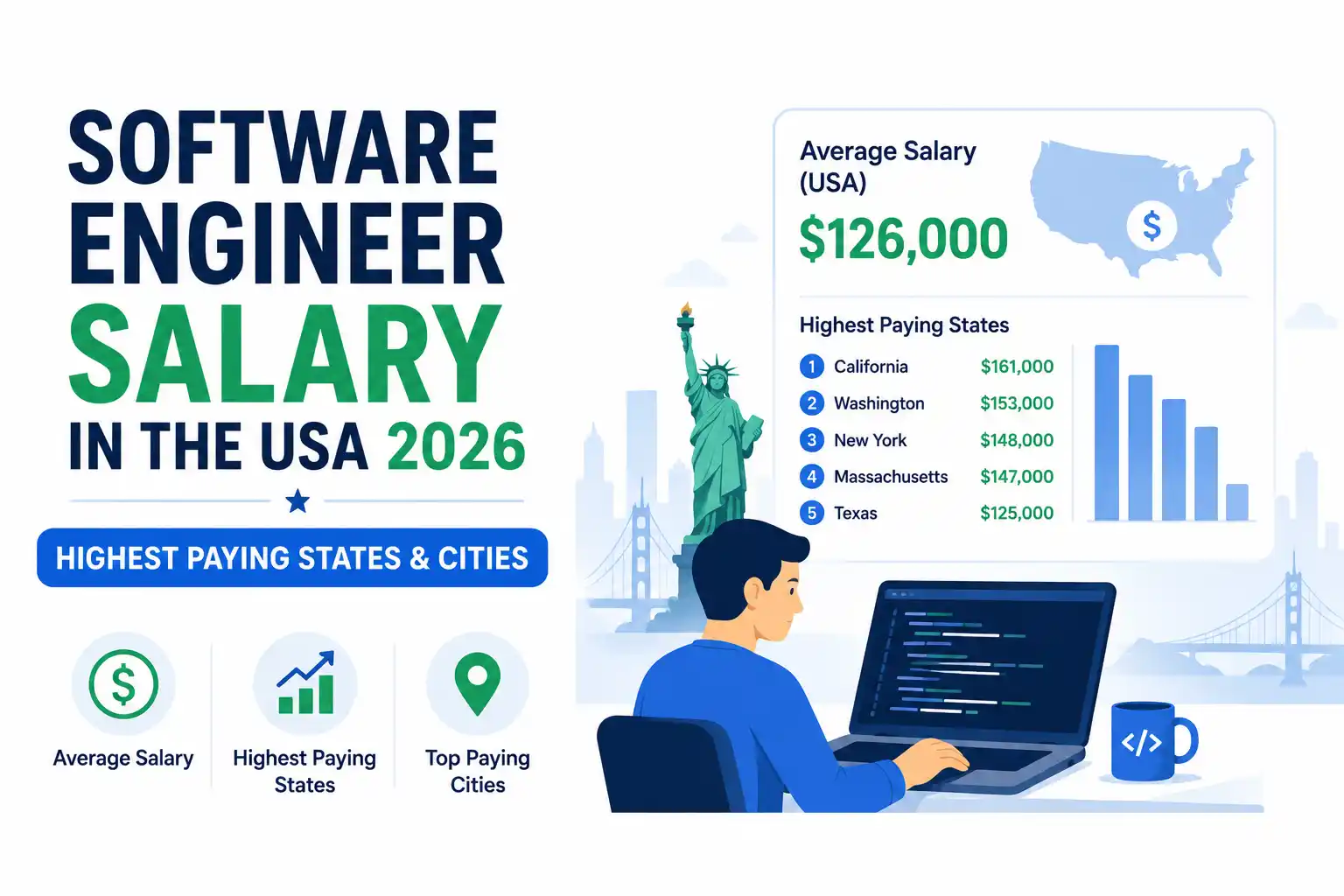
- Highest Paying States in 2026
- Highest Paying Cities — and the Cost of Living Trap
- FAANG vs. Startups vs. Enterprise
- Skills That Pay More Right Now
- Remote Work & the Salary Geography Shift
- Salary Negotiation Mistakes Engineers Make
- How to Actually Maximize Your Pay in 2026
A friend of mine joined a mid-size fintech company in Chicago in 2022 with a $115K offer. He felt good about it. Then, two years later, he connected with a college classmate who’d taken a job at a Seattle-based tech company — same job title, similar experience — earning $240K total comp. Same role. Same years of experience. More than double the pay.
That gap wasn’t luck. It was location, company type, and knowing how to negotiate. And in 2026, those gaps have only grown wider.
Software engineering is still one of the highest-paying careers in America, but the salary data out there is genuinely confusing — you’ll see figures ranging from $130K to $450K for “software engineer” depending on who’s reporting it. This guide cuts through the noise and tells you what’s real, what’s actually achievable, and how to position yourself at the high end.
$142K
National average (2026 estimate, cross-platform)
$133K
BLS median (government-reported, all SE roles)
$400K+
Senior FAANG total comp (base + RSU + bonus)
6%
Year-over-year salary growth rate in 2025–26
The Reality Check Nobody Talks About
Every salary article leads with the national average. That number is real — the Bureau of Labor Statistics puts the median software developer salary at around $133,080 for 2024 data (the most current government figures). By 2026 estimates across platforms like Glassdoor, ZipRecruiter, and Built In, that’s tracking toward $140K–$148K depending on the source.
But here’s the thing: the word “average” is doing a lot of heavy lifting. It mixes a $75K junior developer at a regional insurance company in Ohio with a $420K senior engineer at Google in Mountain View. Those aren’t the same job in any meaningful sense.
The more useful question isn’t “what’s the average?” It’s what can someone with my experience, in my location, with my skills, realistically earn? That’s what this guide actually answers.
Important: Glassdoor and Indeed often report base salary only. Total compensation — which includes RSUs (restricted stock units), annual bonuses, and signing bonuses — can add 30–80% on top of base at tech companies. Always compare apples to apples: total comp, not just base.
What the National Average Actually Means in 2026
Here’s a quick sanity check across major platforms, as of 2026:
| Source | Average / Median | What It Measures | Reliability |
|---|---|---|---|
| BLS (Government) | ~$133,000 | Median, all SWE roles nationally | Authoritative |
| Glassdoor | ~$148,764 | Self-reported, base + some bonus | Strong |
| ZipRecruiter | ~$147,524 | Job posting averages | Good |
| Built In | $139,749 base / $159K total | Self-reported, tech-focused roles | Strong |
| Levels.fyi | $300K–$450K (top-tier) | Verified comp at large tech firms | Best for FAANG |
The takeaway: for general market benchmarking, BLS and Glassdoor are your baseline. If you’re interviewing at FAANG or top-tier tech, Levels.fyi is the gold standard — it breaks down base, stock, and bonus separately, by company and level.
Salary by Experience Level in 2026
Experience is the single biggest lever on your salary before company type and location. Here’s a realistic breakdown — these figures represent total compensation (base + stock + bonus) across a mix of company types:
| Level | Years Exp. | General Market TC | FAANG/Top Tech TC | Startup Base |
|---|---|---|---|---|
| Entry / Junior | 0–2 yrs | $80K – $110K | $160K – $200K | $90K – $130K |
| Mid-Level (SWE II) | 2–5 yrs | $110K – $160K | $200K – $320K | $130K – $170K |
| Senior (L5) | 5–10 yrs | $160K – $220K | $300K – $450K | $160K – $220K |
| Staff Engineer (L6) | 8–15 yrs | $200K – $280K | $450K – $650K | $200K – $300K |
| Principal / Distinguished | 12+ yrs | $250K – $350K | $700K – $1M+ | Varies widely |
Key insight: The senior-to-staff jump is the hardest — and the most financially rewarding. Most engineers plateau at Senior (L5). If you can demonstrate organizational-level impact, not just individual code output, that’s where the massive TC jumps happen at top companies.
The Career Progression Reality
Most engineers reach senior level in 5–8 years. And here’s something nobody tells you clearly: staying at Senior is completely fine financially. Senior engineers at FAANG earn $300K–$450K in total comp. You don’t have to chase Staff or Principal to earn well — you just have to be at the right company.
Highest Paying States for Software Engineers in 2026
State matters, but maybe not in the way you think. California tops the raw salary charts, but when you factor in state income tax (13.3% at the top bracket) and cost of living, the picture changes. Washington state’s no-income-tax advantage is real money.
| State | Avg. Base Salary | State Income Tax | Cost of Living | Verdict |
|---|---|---|---|---|
| California | $115K – $165K | Up to 13.3% | Very High | Highest Nominal |
| Washington | $125K – $160K | 0% (none!) | High | Best Net Pay |
| New York | $120K – $155K | Up to 10.9% | Very High | Top Market |
| Massachusetts | $115K – $150K | 5% | High | Strong Value |
| Texas | $110K – $150K | 0% (none!) | Moderate | Best Value |
| Colorado | $110K – $140K | 4.4% | Moderate-High | Rising Fast |
| Illinois | $100K – $135K | 4.95% | Moderate | Solid Mid-Tier |
| Florida | $95K – $125K | 0% (none!) | Moderate | Growing Market |
| Georgia | $100K – $130K | 5.49% | Low-Moderate | Atlanta is hot |
| Hawaii | $66K – $90K | 11% | Very High | Avoid for pay |
“Texas has no state income tax and significantly lower cost of living. A senior engineer in Austin often takes home more in real purchasing power than the same role in San Francisco.”
Highest Paying Cities — and the Cost-of-Living Trap
Cities are where the real salary action happens. But the city that pays the most isn’t always the city where you’ll keep the most. Let me break down the top markets honestly:
San Francisco / Bay Area
Still the highest nominal salaries in the country. FAANG total comp for senior engineers runs $350K–$500K+. But a 2-bedroom apartment averages $4,500/month, and state income tax bites at 13.3%. A $450K SF engineer takes home roughly $270K after federal and state taxes — which sounds great until you see a 1-bedroom condo selling for $1.2M. It’s still worth it for top-company equity, but do the math carefully.
Seattle, Washington
Home of Amazon and Microsoft — two of the highest-paying employers on earth. Salaries are slightly below SF but Washington has zero state income tax. That alone is worth $20K–$40K per year at high income levels. A $400K Seattle engineer takes home roughly the same as a $440K SF engineer. Housing is expensive but cheaper than SF. Seattle is arguably the best pure-value tech market in 2026.
New York City
Strong market — finance-adjacent tech (Goldman, Citadel, Bloomberg, Two Sigma) pays exceptionally well, often beating pure tech in total comp at senior levels. Pay transparency laws mean job listings must include salary ranges, which helps negotiation. Manhattan rent now rivals SF at $4,200+/month for a 1-bedroom. Still a top-tier market for the right specializations.
Austin, Texas
The story of the last five years. Major tech campuses from Apple, Google, Meta, Tesla, and dozens of startups have transformed Austin into a genuine tech hub. Salaries are 10–20% below SF but cost of living is dramatically lower — no state income tax, housing still relatively affordable. Many engineers deliberately negotiate SF-level remote salaries while living in Austin. This is the “best hack” in tech compensation right now.
Boston, Massachusetts
Underrated. Strong in biotech, AI, and enterprise software. MIT/Harvard talent pipeline keeps the market competitive. Companies like HubSpot, Wayfair, and Biogen pay well. State income tax is a flat 5%, which is actually one of the better rates for high earners. Less flashy than SF or NYC, but the quality of life-to-income ratio is one of the best in the country.
| City | Avg. Base | Senior Total Comp | Avg. 1BR Rent/mo |
|---|---|---|---|
| San Francisco, CA | $165K | $350K – $500K+ | $3,200 |
| Seattle, WA | $155K | $300K – $450K | $2,400 |
| New York City, NY | $150K | $280K – $420K | $4,200 |
| Boston, MA | $140K | $240K – $360K | $2,800 |
| Austin, TX | $140K | $220K – $340K | $1,700 |
| Denver, CO | $130K | $200K – $300K | $1,900 |
| Los Angeles, CA | $135K | $220K – $320K | $2,800 |
| Chicago, IL | $125K | $200K – $300K | $2,100 |
| Atlanta, GA | $120K | $185K – $270K | $1,600 |
| Miami, FL | $115K | $175K – $250K | $2,500 |
FAANG vs. Startups vs. Enterprise — Which Actually Pays More?
This is the question I get asked most often, and the answer is genuinely nuanced. Let’s be real about each path:
FAANG & Top-Tier Tech (Google, Meta, Amazon, Netflix, Apple, OpenAI, Anthropic)
The highest guaranteed compensation. Established pay bands. RSUs at public companies are liquid. Netflix pays the highest base salaries in the industry — no equity, all cash — which appeals to engineers who don’t want to track stock prices. At senior level, FAANG total comp runs $300K–$700K+ depending on the company and level.
AI Startups (OpenAI, Anthropic, xAI, Perplexity, Databricks)
This tier is now competing with or exceeding traditional FAANG for cash, plus the equity upside. OpenAI senior engineers reportedly earn $620K–$730K total comp. The equity is in profit participation units, not traditional RSUs — unusual but potentially very valuable. The risk: pre-IPO equity is illiquid. If the company doesn’t go public or get acquired, paper wealth stays paper.
Series B–D Startups
Lower base ($130K–$180K for senior), but equity packages (0.1%–1.5%) sound exciting. The uncomfortable truth: empirical data shows about 80% of seed and Series A startups exit at zero. By Series B–D, survival odds are better, but dilution eats equity fast. This is a calculated bet, not a sure thing.
Enterprise / Non-Tech Companies
Banks, insurance firms, healthcare companies, government contractors. Salaries are lower (typically 20–30% below top-tier tech), but benefits are often excellent, work-life balance is better, and layoff culture is less volatile. For engineers who don’t want the intensity of pure tech, this is underrated.
The honest verdict: If maximizing compensation is your primary goal, FAANG at senior+ levels wins. But if you weight work-life balance, job security, or startup equity bets — those paths have real merit. Total comp at the top of any category is extraordinary compared to almost any other profession.
Skills That Pay a Meaningful Premium Right Now
Not all software engineering skills are valued equally in 2026. Here’s where the market is paying up:
- AI/ML Engineering: The single biggest salary premium — up to 35–56% above general software engineering. If you can build, train, or deploy machine learning models, you’re in the most in-demand specialty right now.
- LLM / GenAI Systems: Prompt engineering, RAG pipelines, fine-tuning, LLM evaluation — the entire applied AI layer. Companies are paying extraordinary salaries because the talent pool is tiny.
- Cloud & Infrastructure (AWS/GCP/Azure): Cloud architect and DevOps/Platform engineer roles consistently pay 15–25% above general SWE.
- Cybersecurity Engineering: With escalating threats and compliance pressure, security engineers are commanding serious premiums across all sectors.
- Data Engineering: Building the pipelines that feed AI systems is in extremely high demand. Often overlooked, but salaries rival ML engineering at senior levels.
- QA / Test Engineering: Automation has reduced headcount here. Average salaries are 20–25% below general SWE, and the role is being partially absorbed by AI testing tools.
- Legacy Stack Specialists (older COBOL, mainframe systems): High demand in narrow sectors (banking, government) but not a growth trajectory.
Remote Work & the Salary Geography Shift
This is where 2026 genuinely looks different from 2021. The remote work gold rush — where companies paid SF salaries regardless of where you lived — is largely over. Most top employers have moved to tiered salary models.
Tier 1 (SF, NYC, Seattle): Full salary. Tier 2 (Austin, Boston, Denver, LA): 85–95% of Tier 1. Tier 3 (smaller cities, rural): 70–85% of Tier 1.
A few companies still pay location-agnostic (Stripe and GitLab are famous for this). But Meta, Amazon, and Google all apply geographic adjustments now.
The smart play in 2026: specialize in a high-demand skill (AI/ML, cloud), negotiate a Tier 1 remote offer, and then live in a Tier 2 or Tier 3 city. Your nominal pay drops slightly, but your purchasing power skyrockets. Engineers who’ve done this in Austin, Denver, or Raleigh are living better on $180K remote than they would on $220K in San Francisco.
Tools to benchmark remote offers: Use Levels.fyi for comp data, NerdWallet’s cost-of-living calculator to compare cities, and PayScale to cross-check market data. Never walk into a negotiation without numbers.
Salary Negotiation Mistakes Engineers Make (And I’ve Made Too)
I’ve watched friends leave serious money on the table because of these. Don’t repeat them:
- Accepting the first offer. The first offer is almost never the final offer. Companies expect negotiation — especially in tech. A polite counter is standard. The worst they can say is no.
- Negotiating base only, ignoring equity and signing bonus. If they won’t move on base, push for a larger RSU grant or a one-time signing bonus. Recruiters often have more flexibility there.
- Comparing to the wrong benchmark. Glassdoor averages include everyone from junior at a startup to senior at Google. Find data specifically for your level and company tier on Levels.fyi.
- Revealing your current salary first. In many states (including California and New York), employers are legally banned from asking. You don’t have to volunteer it. Let the employer anchor the number.
- Not having a competing offer. Nothing moves a compensation conversation faster than a real competing offer. Even if you love Company A, go through the process with Company B. A competing offer gives you genuine leverage.
- Forgetting to negotiate RSU vesting cliffs. Most FAANG RSU grants vest monthly over 4 years after a 1-year cliff. If you’re leaving a current grant on the table, ask for a replacement grant or accelerated vesting to compensate.
How to Actually Maximize Your Pay in 2026
All the theory above is useful, but here’s the practical playbook:
- Specialize in something high-demand, not just “general SWE.” Even one year of focused AI/ML, cloud infrastructure, or security work shifts you into a different pay band. Platforms like Coursera, DeepLearning.AI, and Microsoft Learn all have solid paths.
- Build a portfolio that demonstrates impact, not just code. GitHub with real projects, contributions to open source, measurable outcomes (“reduced latency by 40%” not “worked on backend systems”). A strong portfolio gets FAANG referrals from connections. A weak one doesn’t.
- Interview simultaneously at multiple companies. This isn’t disloyal — it’s how you create genuine leverage. Run 3–5 processes at the same time. Convert competing offers into negotiation tools.
- Target the right company tier for your experience. FAANG interviews for junior roles are brutally hard. A strong candidate with 3 years of experience might have better odds and outcomes at a well-funded Series C or growth-stage company, then move to FAANG at senior level where interviews assess design and system thinking more than LeetCode grinding.
- Use Levels.fyi before every negotiation. Look up the specific company, specific level, specific city. Walk in knowing what P50 and P75 look like. You’re negotiating toward a data point, not a feeling.
- Ask for performance reviews with equity refresh cycles. At top-tier companies, performance refreshes add new RSU grants each year. Over 4–5 years, this compounds significantly. Ask specifically about refresh grant policies in your negotiation — it’s a long-term comp question that most engineers forget to ask.
Useful Tools & Resources
Levels.fyi Best verified compensation data by company and level. Use this for every FAANG negotiation. Glassdoor Salaries Self-reported market data. Good for broad benchmarks and company-specific base salary ranges. BLS Occupational Data Government source. Most cited in academic and official contexts. Use for baseline credibility. PayScale Cross-reference for skill-specific premiums and industry comparisons. DeepLearning.AI Best place to start building AI/ML skills that command the highest salary premiums right now. Blind (Anonymous Forum) Real engineers sharing real comp data, offer letters, and negotiation stories. Rough but honest.
The Real Takeaway
Software engineering in America in 2026 is still one of the most financially rewarding career paths you can take. The floor is high, the ceiling is extraordinary, and — unlike many fields — the path to higher comp is relatively transparent and achievable through deliberate skill-building and strategic job moves.
But the spread between the average and the ceiling is enormous. A junior developer at a non-tech company in the Midwest and a senior ML engineer at OpenAI are both “software engineers.” Their salaries are five to six times apart. Where you fall on that spectrum is driven by: specialization, company type, location (or negotiated remote tier), and how well you negotiate.
The engineers I know who earn the most aren’t necessarily the best pure coders. They’re the ones who understand how compensation works, benchmark themselves constantly, and aren’t afraid to have the negotiation conversation. That skill is learnable, and it’s worth more than another LeetCode session.
Related Articles Worth Bookmarking
- Levels.fyi Blog — Real Comp Stories & Negotiation Guides The most trustworthy source for verified total compensation breakdowns at top tech companies.
- BLS Outlook: Software Developers (2024–2034 projections) Government job growth projections — 25% growth expected over the next decade. Strong career fundamentals.
- Glassdoor’s Software Engineer Salary Guide Detailed breakdown of salary ranges, industries, and companies. Good for broad market context.
- DeepLearning.AI Blog — AI Career & Skills Insights Understand which AI/ML skills are in demand right now and how to develop them practically.
- Haseeb Qureshi: Ten Rules for Negotiating a Job Offer One of the best practical negotiation guides written specifically for software engineers. Highly recommended reading.
Disclaimer: Salary figures in this article are compiled from multiple public sources including BLS, Glassdoor, ZipRecruiter, Built In, and Levels.fyi as of 2025–2026. Individual salaries vary significantly based on experience, company, specific role, and negotiation. This article is for informational purposes only and does not constitute career or financial advice.